
Timing Is Everything
Learning from Traditions and Becoming a Chef

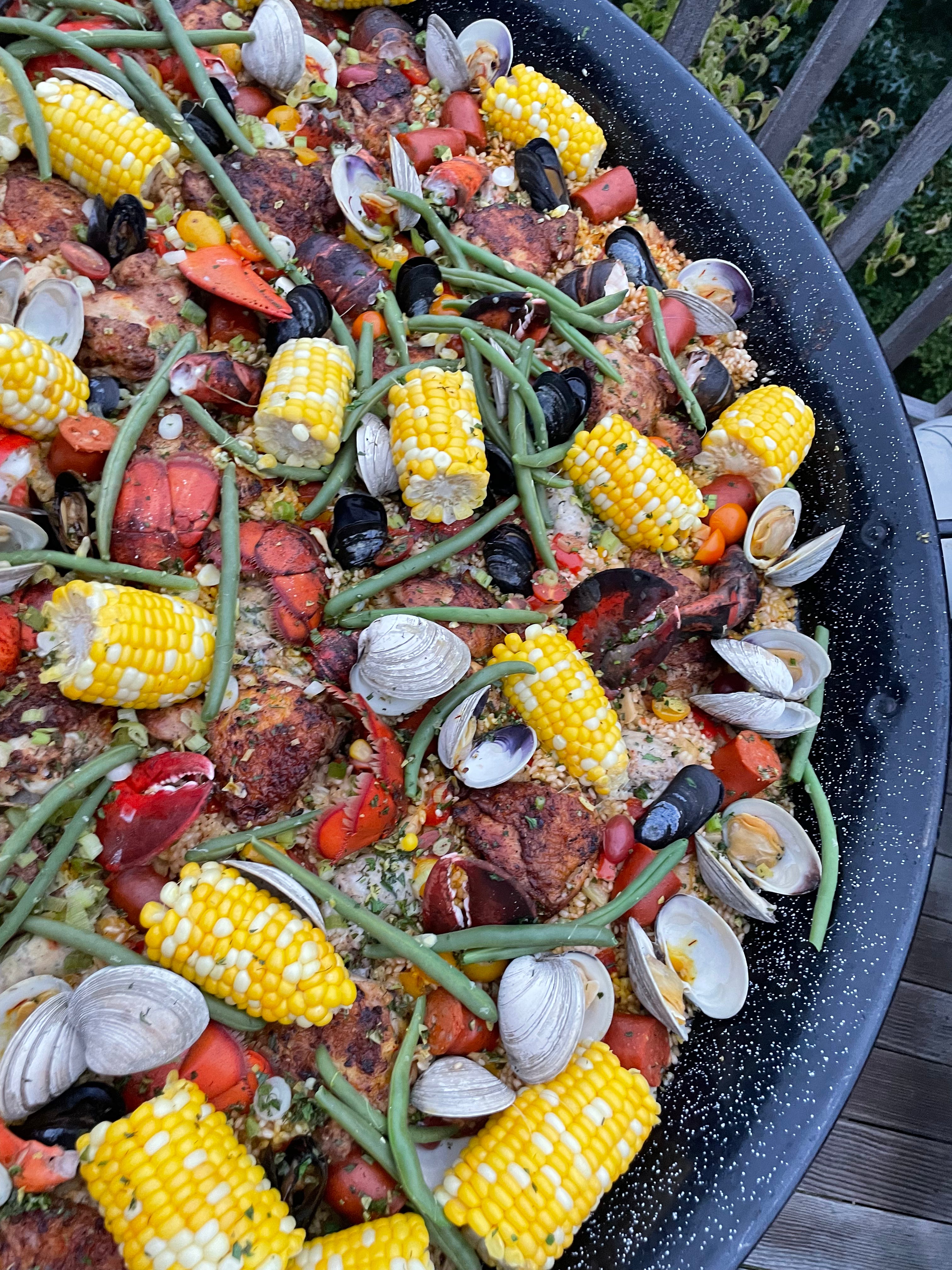
Timing Is Everything: Learning from Traditions and Becoming a Chef
September 7th is the full moon
The evening promises a high tide at 8:10 p.m.
The wood will be lit at 4:30.
At 5:30, the coals will be ready and vibrating, and there will be a low flame. The pan will be leveled and secured, and the oil will be poured over the pan at 5:40. The oil will begin to quiver, and the cooking will begin.
The pan will come off the coals at 6:00.
Timing is everything.
The sun will set at 7:05 and there will be 17 minutes of twilight.
Moonrise will rise at 7:08 in the eastern sky.
The full moons each summer are to be considered with the tides, as these can be especially powerful and evocative of pure summer essence. The Buck Moon, which occurred only two months ago, was on July 10th at 8:17 P.M.
So much changes over the summer.
Moons and beach picnics are always worth considering. The new moon, the sliver, always becomes visible in the west after the sun sets, and it becomes pitch dark. This is when the fire needs to roar to illuminate our faces, and a flashlight to guide us off the beach will be essential.
Learning to cook al paella, the traditional seafood and rice dish of Spain, taught me how to be a chef, a caterer, a mother, a friend. It taught me how to create a lasting memory. A timetable and list of ingredients provide the basic structure, but observing the wind and considering the timing of the tide and sunset are also key to a successful beach dinner. Paying attention to these details honed my skills in executing a paella for twenty or for a wedding for two hundred.
I learned about paellas in Spain, along the banks of the Mediterranean Sea, in a small village called Nerja. With friends, our family rented a house overlooking the sea, and at dusk we would walk along the shore lined with fire pits where whole fish on cross skewers roasted over embers.
Paella pans as big as two outstretched arms sat over the coals, encircled in smoke. We were drawn to the essence of this beach life and inspired by the simple process of the meal. Cooking over fire brings back our primal souls and taps into that which calls us to remember where we are. And oh man, the fun of eating out of one dish!
When I travel, I visit the local markets and restaurants in pursuit of ingredients and menus, seeking to replicate dishes from the region. I have learned to cook through my experiences, not unlike a musician who interprets a song. Once I have sampled a dish, I can recreate flavors according to my own taste, and this is how I have evolved from a self-taught cook to a chef.
A paella is all about precision and planning, and yet is so very basic. A great base, a solid broth, and rice with saffron are essential; after this, the ingredients can vary according to what is at hand.
Spain and Italy, in particular, taught me to use what is available and not worry about recreating something if you don’t have the ingredients the recipe calls for. And there are many variations of paella in different regions of Spain. In Barcelona, Fideuà is a cousin to paella in that it is similar–it features a short, thin pasta instead of rice, cooked in the same way in the large round pan. Arroz Negro, originating from the Valencia and Catalan regions of Spain, is a type of paella made with squid ink and is characterized by its deep, dark, and bold flavor. I also enjoyed the most luxurious of paellas cooked at the home of the famed, humanitarian, Spanish chef José Andrés in his home in Washington, DC, with squid ink and duck liver. What these paellas have in common is a well-tended stock or broth and rich, vibrant ingredients.
Once home on Martha’s Vineyard, I practiced, slowly building layer upon layer of techniques, trusting that no two paellas and no two fires or beach settings would be the same. One summer of paellas led to another, and it continues now as a summer tradition. I have made hundreds of pans of paella over the past twenty-plus summers. I was once a busy caterer and an often unavailable mom, but I continue to find great pleasure in bringing a meal together. I found the paella sealed the deal with what I can make possible for those I love. And I brought paella to so many clients; it was also a traditional summer offering for catering.
My own weekly ritual has become well-oiled and flows in a rhythm: checking the tide, checking the weather, calling friends, loading the car, heading to the beach, unloading, building a fire, going for a swim, and beginning the slow process of cooking a paella over coals.
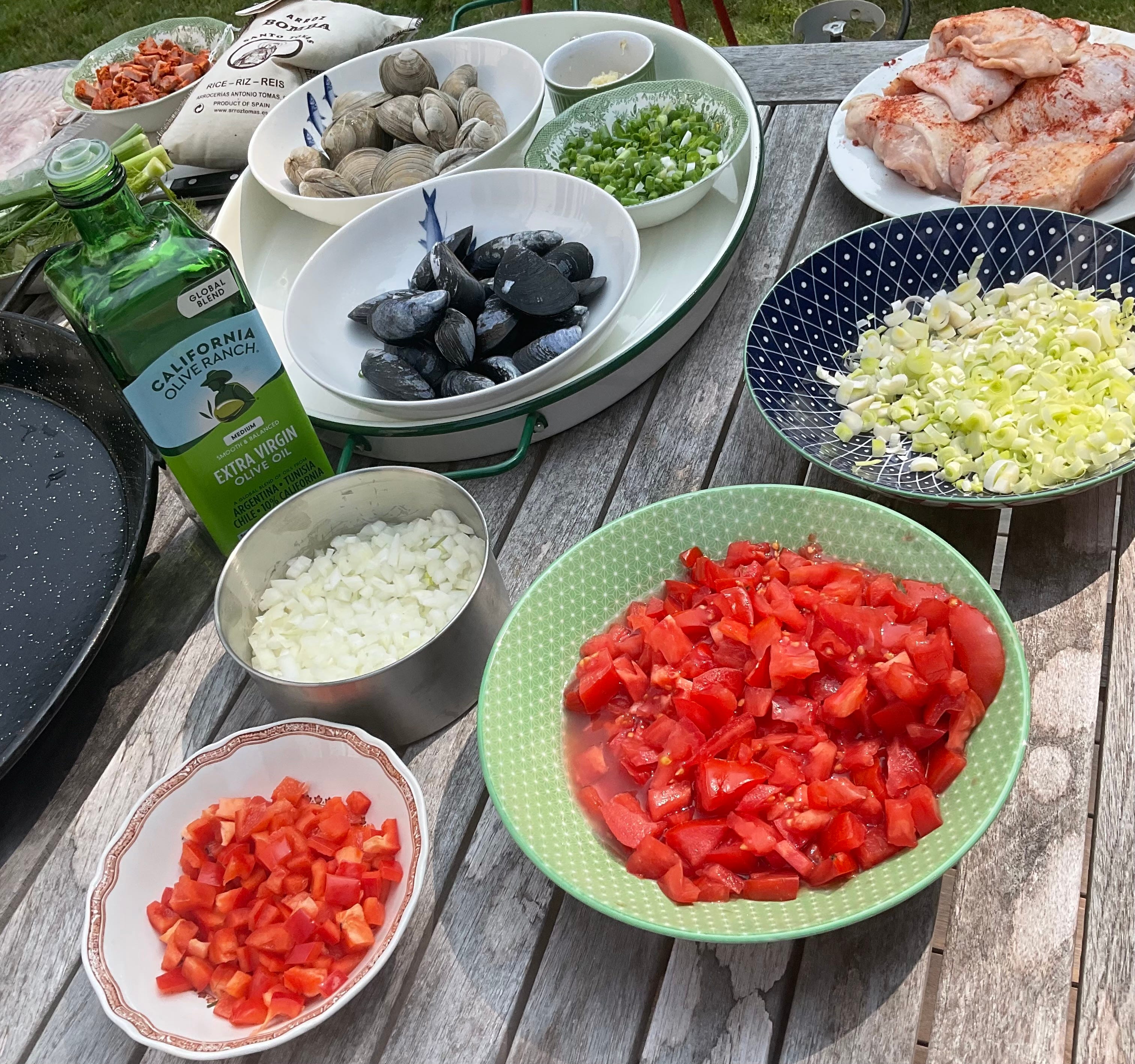
Mise en place
The cooler is filled with all the ingredients. Mise en place (pronounced “mee-zohn PLAHS”), a French culinary phrase, translates to “putting in place” or “gathering.” Everything must be prepped and ready for the pan: the sofrito, the stock, the chicken (seared), and the shellfish (cleaned and counted, finely diced (brunoisé in French) vegetables, a container of premeasured white wine, and triple sec. The technique of perfect hot, but not too hot, embers.
In preparation, we begin with a paste for the base. Salmorreta is one of the secrets behind the magic of the paella. It is often referred to as the sofrito (a paste made as a base). Learning to slow-cook this sauté of aromatics is the first lesson in becoming a chef. It is a base found in many types of cuisines: sofrito in Spanish and Latin America, mirepoix in France, and the Creole Cajun Trinity are cultural examples of a mixture of vegetables that provide a subtle, rich, and essential base. The components of the sofrito may vary: tomato, onion, and garlic are perfect, but some cooks add pimentón, fresh herbs, or a dried sweet red pepper. Often, my base is onions, garlic, fennel, and peppers. Whatever combination is used, it is cooked into a thick mixture that retains its shape when spooned.
A well-flavored broth is another must. The broth must be so deep and rich that you can drink it on its own. A good stock elevates all soups, stews, risottos, and paellas and is essential in a chef’s kitchen; it’s a technique that must be mastered. (Sorry! Nothing out of a box will ever make great paella.) This, too, is about what you have at hand. Use that chicken and lobster if you have them. Substitutions can be made, but the greens of leeks, green onions, celery, and fennel have great purpose here. I begin with leeks, carrots, celery, fennel, and a chicken carcass. If I have mussel, clam, or lobster bodies, they go in, too. Aromatics such as bay, thyme, peppercorns, kombu, mushroom stems, corn cobs, tarragon, and sliced lemon are added to a slow simmer, resulting in a remarkably delicious final product. Then we add a reasonable amount, let’s say a generous amount, of saffron to the stock.
Good rice is a must. Calasparra rice would be the best, being the one that has Denomination of Origin status (specific to the region and tradition). It is a denser, more absorbent grain. Arroz bomba rice is also an excellent-quality paella rice, preferably cultivated in the Valencian region. The grains are short and pearly and well known as paella rice. Arroz bomba is similar to Arborio rice, which is used in Italian risotto, but it gets softer. Paella rice should be slightly dry and grainy. Bomba rice absorbs almost three times its volume in flavorful stock without bursting, retaining a delicate crunch.
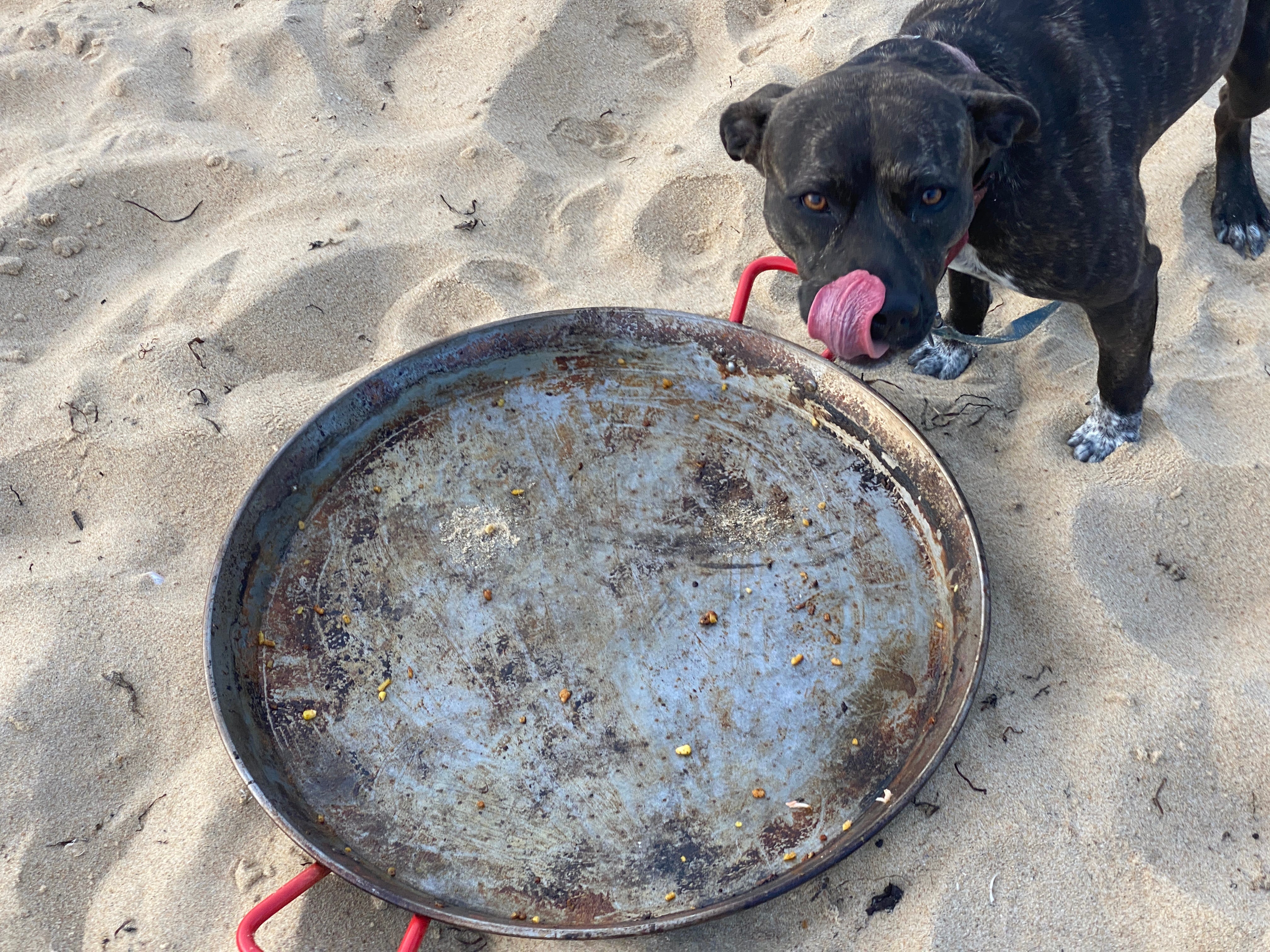
The vessel is what makes this dish, and the word paella is both the dish and the pan. It is no more than two inches high and is round with two, three, or four handles, depending on the size. The 24-inch pan is perfect for eight to ten guests, and the 36-inch is ideal for twenty diners, while the 48-inch with four handles is perfect for thirty to fifty guests—you will need help moving it around the fire, with four hands wrapped in hot mitts. Heavy-duty carbon steel pans are the most traditional and economical. Still, they are best for professionals who know the care and attention that go into maintaining these pans and preventing them from rusting. There is stainless steel and also enamel-coated steel for the home cook.
Tradition calls for open-fire cooking. The salt air and the smoke cannot be captured anywhere else but the beach. And there is the ancient, rhythmic with twelve-hour tides, the moons, and the sky painted in multiple strokes of colors and textures, predictable, yet never the same.. You can taste the smokiness in the paella of the charred wood and the damp salt air that settles just as the dish is presented. The smokiness on the clothes worn to a paella campfire will linger for days.
The moon at the height of each summer on the beach evokes memories. The tide is highest at the full moon, and often the blue moon, the second moon that comes twice in one month, comes at the peak of the summer. The gravitational pull of a solar tide and a lunar tide can make for higher and lower tides, commonly called spring tides. Ideal conditions for paella night are a soft wind and a low tide at 5 p.m.
Ah, but the technique . . . It is all about precision and planning. And yet a paella is also very basic. It’s about using what is freshest. It may be pastured chicken and pork or lamb sausage, whole garlic cloves, and shellfish just out of the ocean–– all of these make a quintessential flavor. By mid-August, you can smell vegetables growing, and the tomatoes are falling off the vine, corn is ripe, and the beans and peppers are so flavorful that they are screaming to be added to paella!
When all of the ingredients are in the pan, we wait, feeling with our hands the soft vibrations of the socarrat being formed. This is the prose of the paella, the crunchy, just-amber crust of the rice at the bottom of the pan. The coals are soft and glowing at this point.
We pull the pan off the coals when it is ready and sprinkle the top with fresh lemon juice flicked from our fingertips, along with salt and chopped herbs and a gremolata––chopped parsley, lemon zest, and minced garlic, ready to add zest and pop!
Once we have removed the pan, we ignite stacks of wood over the embers, and the roaring fire offers us perspective for the future. It’s all there, holding us captive, often lost in conviviality. We choose nights when the wind blows less than 2 knots, which translates to 4–6 miles per hour, a light breeze. One cannot have it more than that or live ashes will be blowing out of the pit. Just enough for the water to lap at the edge and the breeze keeps the coals going. And if one stops long enough to notice, the ocean and wind breathe as one. The sky dissolves into the ocean, and the air holds scents of minerals and fog, fish, and clay, and there is ripeness that is both sharp and subtle.
Each of us scoops a plateful. And we know why we came. All the schlepping and hauling and laughter is worth it. Yes, it's friendship and yes it is the essence of a beach life, but the rice. Even when we burn it a bit too much, we all declare it's better than ever!
Every Tuesday became beach Paella night.
We would invite friends and neighbors. Each week was a different tide and the sunset earlier and earlier as the summer unfolded. We tucked ourselves into a rocky nook overlooking the southern beach of the Atlantic. Each family brought their own glasses, plates, utensils, more wood, amazing salads and cheese, delicious wines and pies.
We would eat from the large pan and then build a large fire from the embers and sit around, lost in fire conversations and tales of remembering when.
Our souls grounded and transfixed as ancient beings, telling timeless stories.
“Yes, we can come to our house if it rains, and it will be delicious...
But…” I linger, hesitant, and trust nature and know in my heart there is no control over too much wind or rain. Being around a table together will be jolly, but the vast shallowness without the moon and tide and water's edge…leaves me caught between the experience and the reality! If it rains, it's no fun; if you don’t have serious lifters and folks who can pitch in, then it's too much work.
The schlepping and hauling takes more than being organized, and it needs to be a serious team effort, and if it’s not there, then the porch or backyard will just have to do.
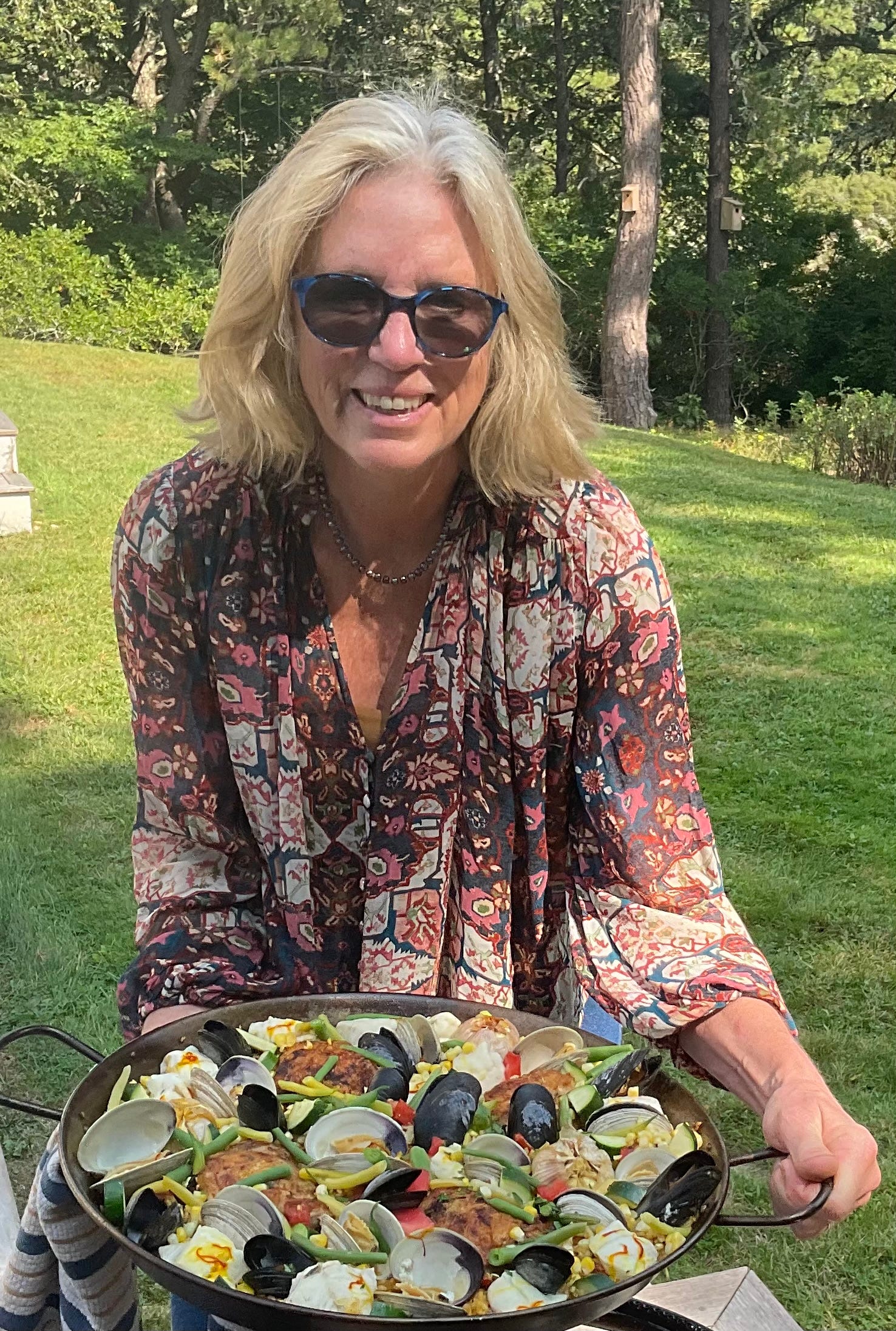
It’s become the Martha’s Vineyard dish, and it may just pass the clambake in popularity. Paellas continue to be a part of many nights of the summer. A few years ago, a friend asked me to cook a kosher paella. It lacked all the essence of a paella. But each year, she asked again and again, and like any tradition, it is built layer by layer. I have come to make an amazing stock for this kosher pan. Yes, chicken stock, but the stems of mushrooms and corn cobs create a depth of flavor that reaches your soul. I learned to puree the corn kernels with the stock, which became almost a cream soup due to its thickness. Blue fish was added, and the top was topped with piles of local sautéed mushrooms, halved cherry tomatoes, and handfuls of shucked corn. It has become something I can bring to this family every summer.
Our family was always the last to leave. We knew it was late when the beach started filling up with fishermen and the dampness of the evening coated us. We would discuss our options: sleep on the beach or head home. We always discussed this. We never planned it; we didn’t have sleeping bags or blankets, and it was always a bit too damp to be without them. Then the sand fleas would often find us. My son claims there were many nights we stayed and slept on the beach, and I believe he has mixed up his late-night teenage party nights with his younger days, as I don’t recall such an evening. We would pack up the car and often roll in late with sleeping children, folded chairs, loads of sand, piles of wet towels and tablecloths, collected rocks and shells, and an ocean-rinsed pan. “Beach schleppe,” I would call it. It was a mess, but it was our Tuesday night tradition.
Oh, there are stories over the years, and of course, we all have our own versions we can argue about.
The family that showed up with pizza in a cardboard box and a flashlight big enough to light up a gymnasium, who left their bottles and boxes behind for us to carry home. That sort of set the tone for who could be invited after that!
And sadly, it took the wind out of our sails for “hosting” the Tuesday night rituals of summer. But there are many memories. The night the bluefish were jumping out of the water, one of the kids caught one with his hands, and then two were caught and we gutted and cleaned it with a knife right there and cooked it over the coals (always have a sharp knife on hand!)
And the spirit of Al, who joins me in the clouds and waves of the ocean through spirit, was our neighbor’s father. He could not wait for our paella parties. His love of sausage, especially hard salami, which he brought and always gleefully shared, was contagious. His feet shuffled faster than his body could carry him over the treacherous beach of boulders and rising tides, as he arrived breathless and always with gusto.
I am reminded of a time years ago when one of our sons was about 17 and in that stage of not really wanting to be with us. We were gathered at the beach for yet another paella party when he shared that making paella on the beach over an open fire was his favorite summer memory. We recalled the fires we built and the great times we had with so many friends, and one memory stood out: the kids building their own fires and the adults building theirs. I also remembered that long-ago night when the beach had seven or eight fires, all created by the kids as a challenge to see who could build the best fires.
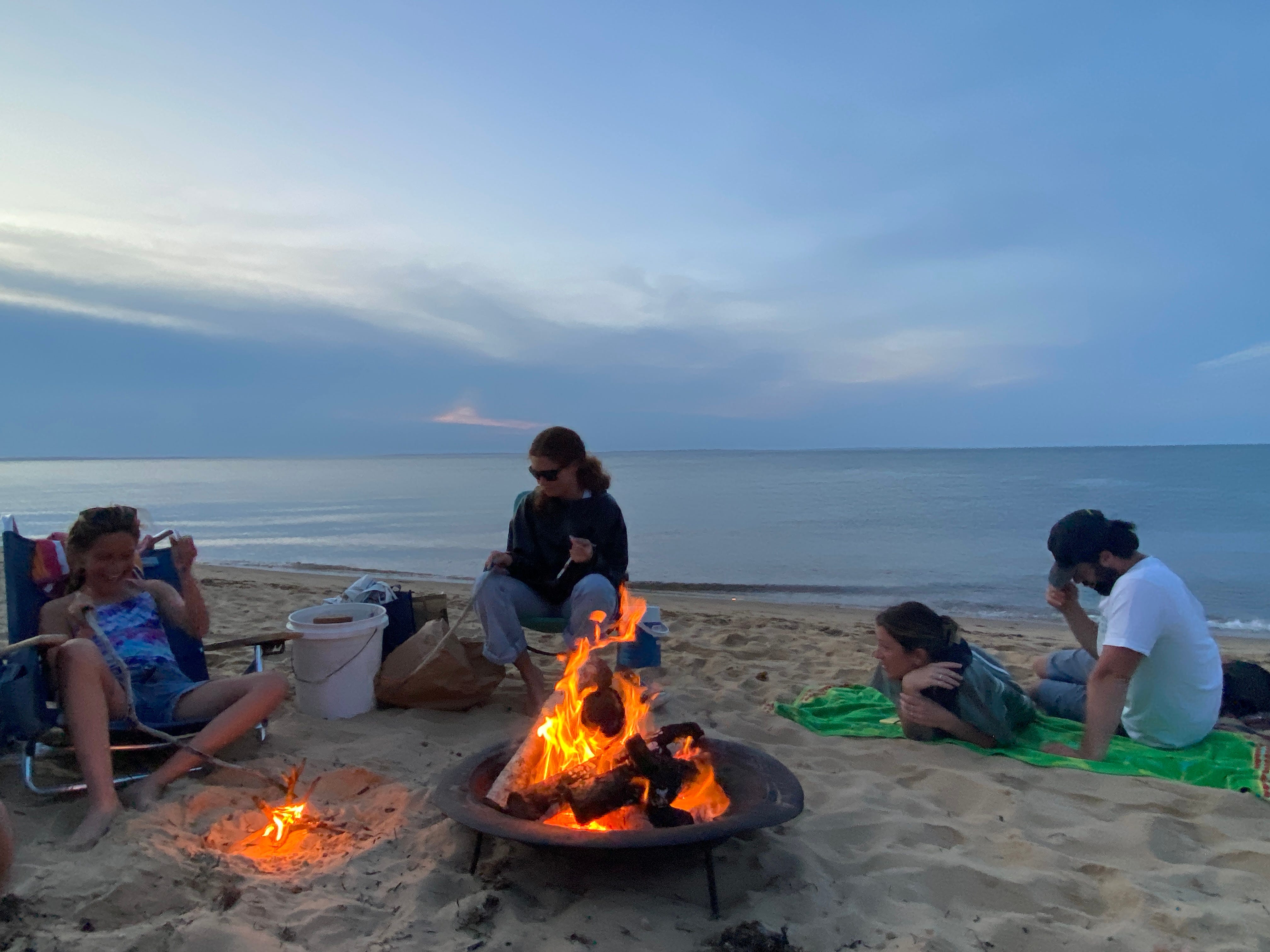
Each of us has a story of a forgotten time.
And that story sparked a memory I had forgotten.
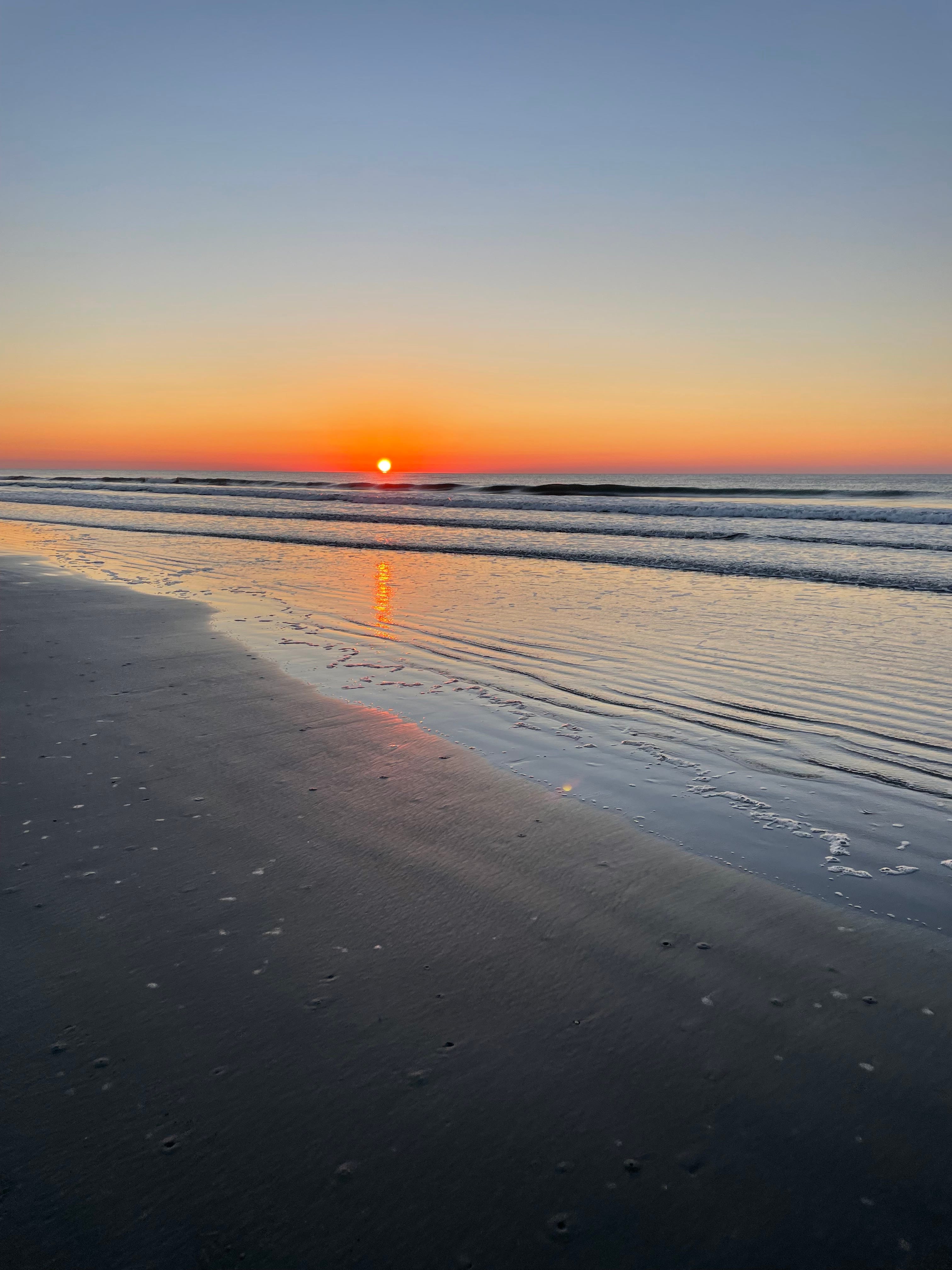
I would often take a swim at twilight, that moment when the veil between the spirit world and ours becomes a shred of insight to something more powerful, yet insignificant, and bold. That one glimpse of the day that marks its end forever. I remembered that swim as I looked back at the shore with our friends and kids and their line of fires. That one tiny moment had fossilized, and I was able to capture it again. My thoughts of the vastness of the world and how small we really were—meaningless, really, but just like the stones that have been here forever, rarely do we see them until we find one that captures our attention. Our lifetime with our friends and family is so short compared to the formation of rocks and boulders. I remembered my thoughts as thoughts, reminiscing of my days along the Mediterranean Sea and how there is a tiny sliver that connects the Atlantic Ocean, the edge of the North American shore, to the edge of the European shore, where I was inspired by tradition and I learned to cook over open fires. Our waters are connected, and who could predict that that experience would bring us years of recreation?
Next year, August 15 is the full moon; the sun will set at 8:16, and the full moon will rise at 8:31. The tide will be at its lowest at 4:34 and will gradually edge closer to our fire, and around 11, the tide will be high, signaling us to head home. And another paella will be served.
Like the genie who predicts the future and gives you one final wish.
I feel as though the lamp was rubbed for me on the banks of the Mediterranean, and my path was set. And not unlike a well-worn boot that becomes so cozy and familiar, I want nothing else. Who could know that the paella could become our tradition for beach and summer and fires and stories and who could predict that the learning of the technique could make me the chef that I am, the caterer I became, or the mother I always wished to be.
Who would know that time in Spain would lead us to copy what we saw and recreate our own versions? We wanted to capture the essence of a meal so delicious that it sets your heart on fire.
Consider joining me on one or two upcoming retreats
I will be leading a culinary trip to the Azores in April
Or consider a wellness retreat all about Gut Health with John Bagnulo
Recipe for Paella below
